There is a particular kind of magic that happens when you settle in for a quiet evening with a small batch of yarn. The house is still, the lighting is soft, and your hands find their rhythm in the familiar click of the hook. Counting stitches becomes a meditation, and the relaxing repeat of the pattern allows your mind to drift while your fingers work. This is the ritual that makes the Lilac Lane Crochet Afghan such a joy to create. It is a project that invites you to slow down, embrace the flow of color-transitioning yarn, and build something beautiful one stitch at a time.
Small Details That Make It Better
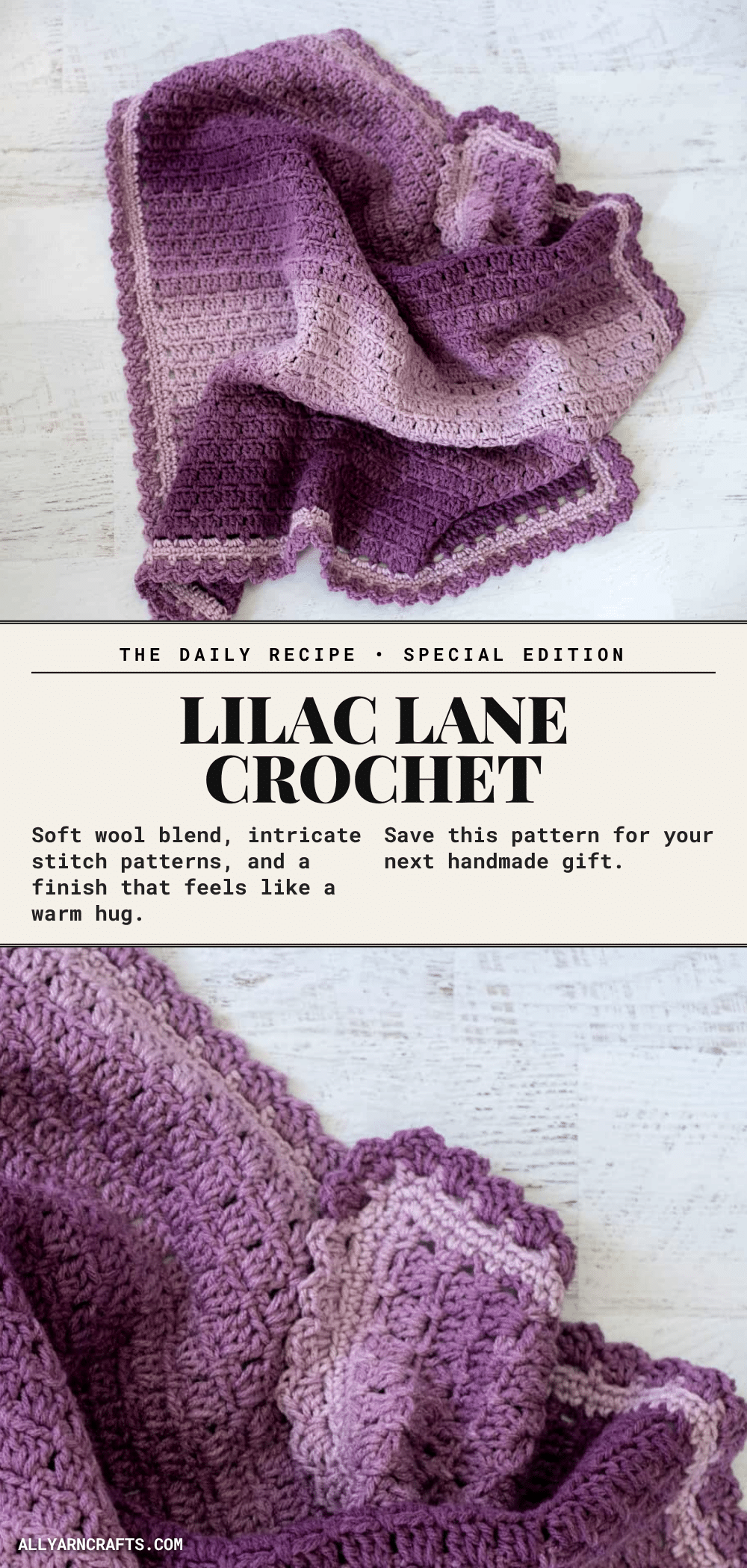
What truly elevates this afghan is the interplay between the airy, open texture of the main body and the structured elegance of the scalloped border. The blanket stitch pattern creates a fabric that is lightweight yet substantial, perfect for draping over a sofa or wrapping around a newborn. The choice of Red Heart Super Saver Ombre in purple allows the color to shift subtly, ensuring that no two rows look exactly alike. While the main body relies on a simple two-row repeat, the border adds a layer of sophistication that transforms a basic square into a heirloom-quality piece. The specific attention to corner placement ensures that the final shape remains crisp and symmetrical, proving that a few small adjustments in technique can make a significant difference in the finished look.
Project Overview
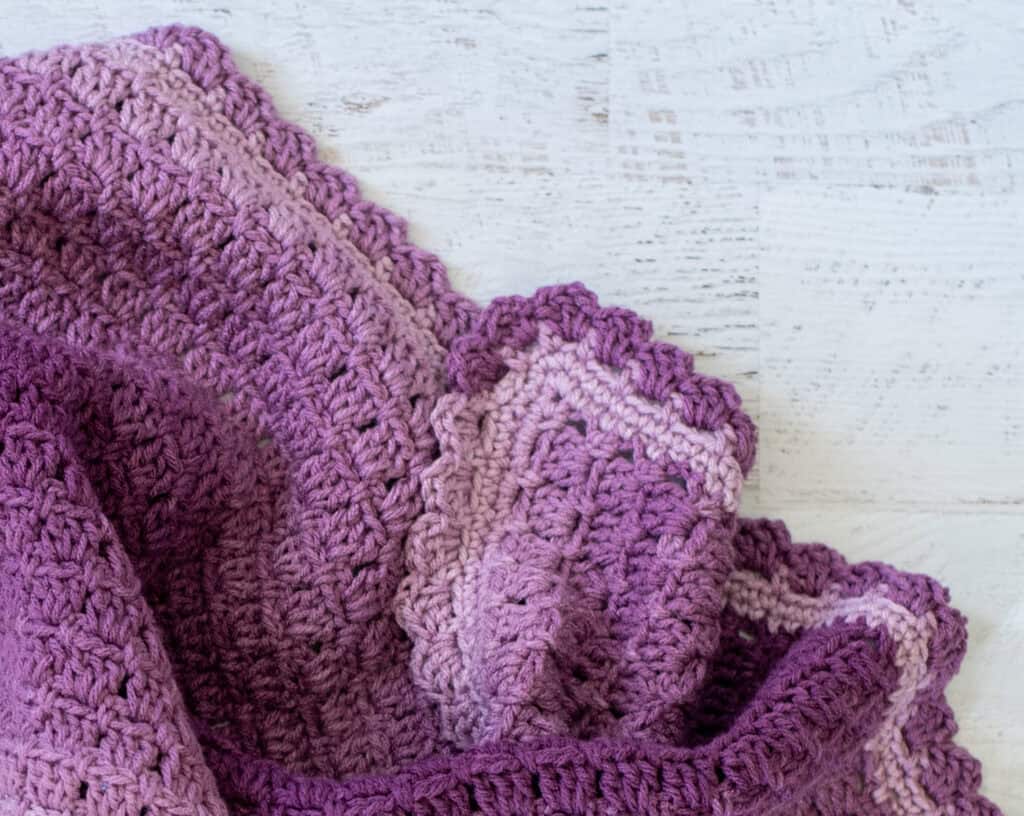
The Lilac Lane Crochet Afghan is a versatile project that works beautifully as a baby blanket or a cozy throw. It utilizes basic stitches in a simple two-row repeat, making it accessible for crocheters of all skill levels. The design features an open, lacy main body created with single crochet and chain spaces, finished with a decorative scalloped border. The pattern is easily adjustable; you can change the size by altering the starting chain in multiples of three, allowing you to customize the afghan to your specific needs.
Materials
- Red Heart Super Saver Ombre, size 4 worsted weight, 100% acrylic (482 yds per 10 oz skein)
- Color: Purple (700 yards required)
- US I9/5.5mm crochet hook
- Tapestry needle
- Scissors
Gauge and Finished Size
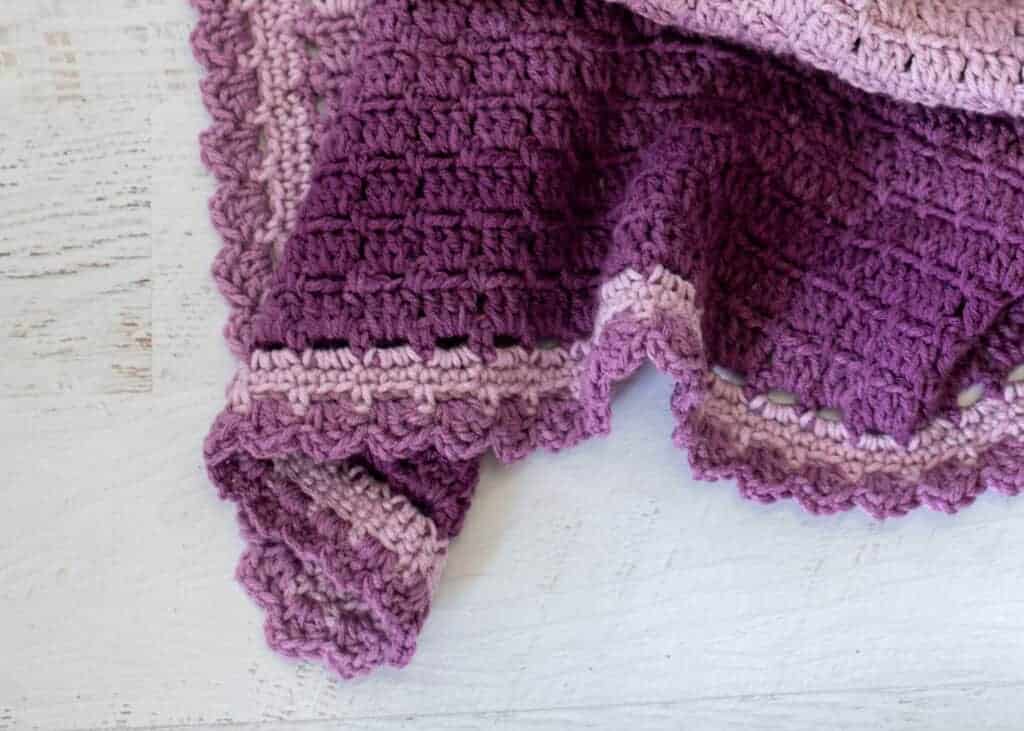
The finished blanket measures approximately 31” x 31”. Because this pattern relies on a stitch repeat rather than strict gauge, the exact tension may vary slightly by maker. The key is to maintain even spacing throughout the work.
Abbreviations
- ch(s) = chain(s)
- cluster = 3 dc worked in one space
- dc = double crochet
- sc = single crochet
- st = stitch(es)
Pattern Notes
- Adjusting Size: To make the afghan larger or smaller, chain in a multiple of 3 plus 1 more stitch to the length you desire.
- Border Tension: Specific stitch count matters less than keeping even spacing of stitches. If your border begins to curl, you are working too few stitches. If your border begins to ruffle, you are working too many stitches. Rip out in either case and try again to maintain a flat border.
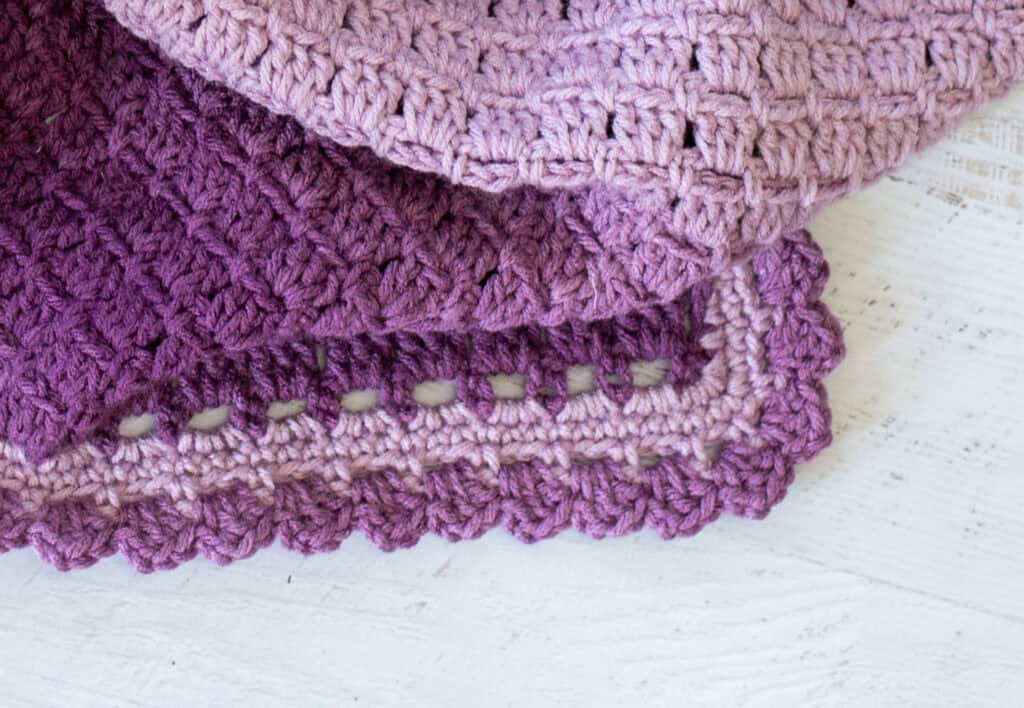
- Corner Placement: It’s important to work the corners as described over the 3 corner stitches from the prior row. You may need to adjust the stitches you skip prior to the corner (skipping 1 instead of 2 stitches) to make the corner work properly if your stitch count isn’t a multiple of 3.
Pattern Instructions
Blanket
Row 1: Ch 100. (Note: to make afghan larger or smaller, chain in a multiple of 3 + 1 more stitch to the length you desire). Sc in 2nd ch from hook, sc in next ch, *ch 2, skip next 2 ch, sc in next ch, repeat from * across, ending with a sc in the last ch. Turn. (32 ch-2 spaces, 35 sc)
Row 2: Ch 3 (counts as 1 st st), 3 dc in each ch-2 space across, ending with one dc in the last sc of row. Turn. (32 clusters, 2 dc)
Row 3: Ch 1, sc in 1st st, sc in space before next cluster, *ch 2, skip cluster, sc in next space. Repeat from * around. Sc in the last st of the row.
Repeat rows 2 and 3 until the blanket is square. Fasten off and weave in ends.
Afghan Border
Round 1: Attach yarn with a slip stitch to any stitch and ch 1. Sc around afghan, spacing sc stitches evenly on edges and working 3 sc in each corner stitch. Join with a slip stitch to the top of the first sc in the round. Note: Specific stitch count matters less than keeping even spacing of stitches. If your border begins to curl, you are working too few stitches. If your border begins to ruffle, you are working too many stitches. Rip out in either case and try again to maintain a flat border.
Round 2: Ch 1, sc around, working 3 sc in each corner stitch. Join with a slip stitch to the top of the first sc in the round. Fasten off yarn.
Round 3: Re-attach yarn with a sl st to the 6th st to the right of a corner (excluding the corner stitch). Ch 1, sc in in same st, ch 2, *[skip 2 st, sc in next st, ch 2] around until the 3 corner stitches from prior round, then sc in next st (this is in the 1st of the 3 corner stitches), ch 2, skip next st, sc in next st (this is 2nd of the 3 corner stitches), ch 2. Repeat from * around, making sure to only skip 1 stitch at the corners. Join with a slip stitch to the top of the first sc in the round. Note: It’s important to work the corners as described over the 3 corner stitches from the prior row. You may need to adjust the stitches you skip prior to the corner (skipping 1 instead of 2 stitches) to make the corner work properly if your stitch count isn’t a multiple of 3.
Round 4: Ch 1, (sc, ch 2, 2dc) in ea ch-2 space around. Join to top of 1st st. Fasten off and weave in ends.
Assembly
Weave in all ends securely using a tapestry needle. Block the finished afghan if desired to even out the stitches and enhance the drape of the fabric.
Tips
- If you are new to this stitch pattern, consider reviewing basic crochet blanket techniques to ensure your tension remains consistent.
- Use a stitch marker to keep track of the beginning of each round, especially when working the complex corner instructions in Round 3.
- For a more structured finish, consider using a slightly smaller hook for the border rounds to tighten the edge.
FAQs
Can I use a different yarn weight?
Yes, you can change the yarn weight for a lightweight or bulky afghan. However, you will need to adjust your hook size accordingly and may need to modify the starting chain to achieve the desired finished size.
How do I fix a border that is curling?
If your border curls, you are likely working too few stitches. Try adding more single crochet stitches evenly around the edges, particularly in the corners, to help the fabric lie flat.
Is this pattern suitable for beginners?
Absolutely. The main body uses basic single crochet and double crochet stitches in a simple repeat. The border adds a bit more complexity but remains manageable for those with basic crochet knowledge.
Can I make this afghan rectangular?
Yes, simply continue the two-row repeat until the blanket reaches your desired length. The border instructions can be adapted to work around the longer sides by spacing stitches evenly.
Why do I need to skip specific stitches in the border?
The specific skipping pattern in Round 3 creates the scalloped effect. Adjusting the skipped stitches at the corners ensures that the scallops align correctly and the corners remain flat rather than ruffling.
Pin This Crochet Pattern!